Towing is one of the few services people buy without ever seeing a price list. You are usually stressed, often on a shoulder, and the number arrives after the decision. That is a bad way to buy anything.
So here is how towing is actually priced in Calgary and the surrounding towns, what pushes a bill up, and the questions that get you a straight answer.
The basic structure: hook-up plus distance
Nearly every light-duty tow in Alberta is built from two numbers.
The hook-up fee is the base charge for sending a truck and loading your vehicle. It pays for the driver's time on scene and for the equipment being there rather than somewhere else. It applies whether you are going two kilometres or twenty.
The per-kilometre rate is added on top, usually measured from where the truck picks you up to where it drops you.
This structure is why people are surprised by short tows. Moving a car three blocks still requires a truck, a driver and the same loading work as moving it across the city. The distance is the cheap part.
What actually moves the price
The equipment the job needs
This is the biggest single factor and the one most people do not anticipate.
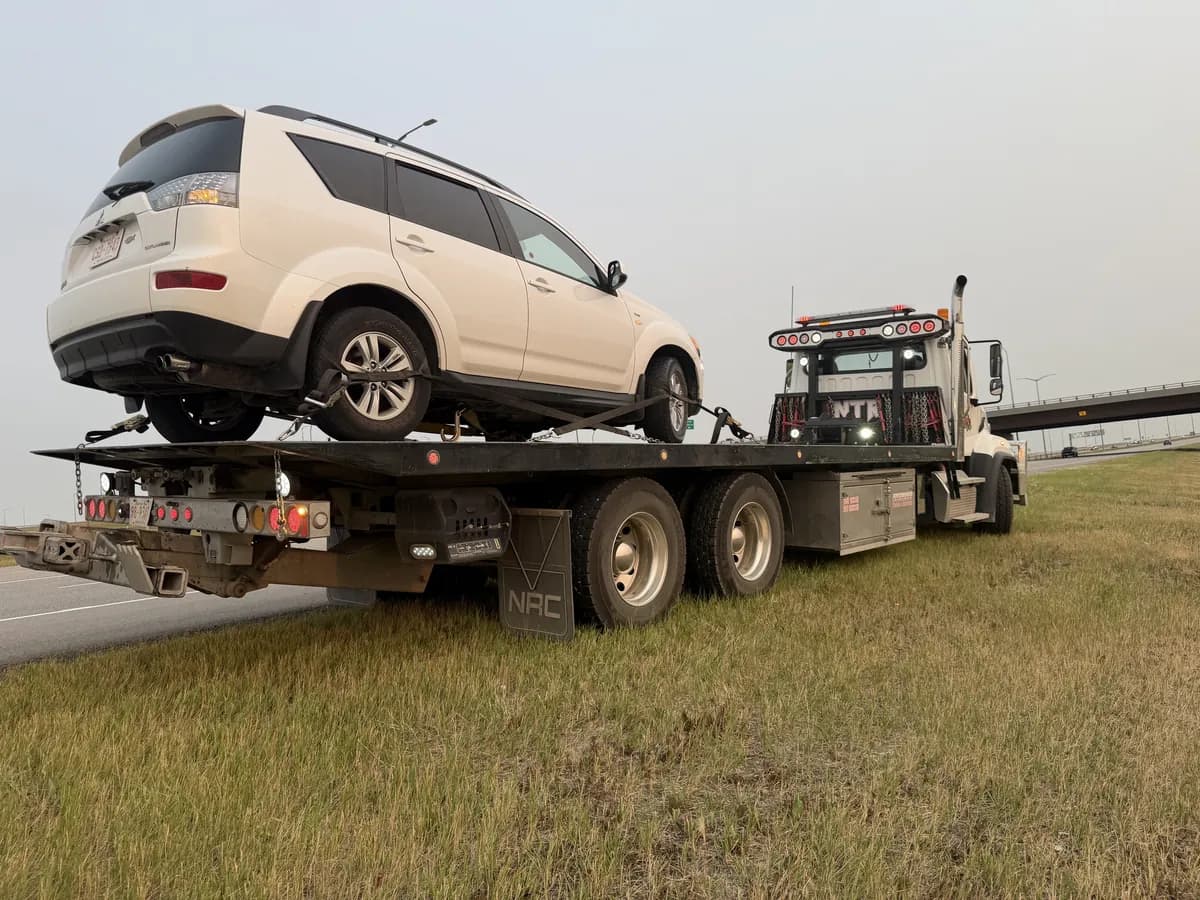
A standard flat deck handles most passenger vehicles. But a vehicle in an underground parkade needs wheel-lift equipment with low clearance. A vehicle that has left the road needs winching. A commercial unit needs a heavy wrecker. Each step up is a more expensive machine with a more qualified operator.
If you describe your situation accurately on the phone, you get the right truck first time. If the wrong truck is sent, somebody pays for the second trip — and it is rarely the company that guessed.
Whether the vehicle rolls
A car that rolls freely gets winched onto a deck in a couple of minutes. A car with a seized wheel, a snapped axle, locked brakes or accident damage needs skates, dollies or rigging, and the time on scene multiplies.
This is also true for equipment. "Does it roll?" is the question that most changes what a heavy haul costs.
Where it is
A vehicle on a flat, dry shoulder is a straightforward load. The same vehicle thirty metres down a ditch bank in spring melt is a recovery: winch line, time, and often a second unit to anchor.
Around Calgary, the places that reliably turn a tow into a recovery are the Highway 1A hill into Cochrane, the QEII north of Balzac in a ground blizzard, the exposed stretches of Highway 2 south of Aldersyde, and the median on Deerfoot Trail, where getting to the vehicle safely is half the job.
The time and the day
Overnight, weekend and holiday call-outs generally carry a surcharge. A company that keeps a driver and a truck available at three in the morning on a long weekend is paying for that availability, and the rate reflects it.
Storage, if the vehicle stays
If your vehicle goes to a compound rather than straight to a shop, storage is usually charged daily and starts immediately. This is where towing bills quietly become large. If you can nominate a destination when you call — your shop, your dealership, your driveway — do it, and you avoid storage entirely.
Heavy-duty is quoted, not metered
Everything above describes light-duty work. Heavy-duty towing and recovery are priced differently, and it is worth understanding why.
When a highway tractor goes into a ditch, nobody knows in advance how long the recovery will take. It depends on the angle, the ground, the load, whether the trailer has to be unloaded first, and whether traffic control is needed. A per-kilometre rate would be meaningless.
So heavy work is quoted per job, based on the equipment required and the expected hours. For planned moves — relocating a forklift, moving a tractor between sites, hauling a tank unit — you should get a firm number before anything is committed, because all the variables are known up front.
The questions worth asking
Before you agree to a tow, ask:
- What is the hook-up fee, and what is the per-kilometre rate?
- Does this job need winching, and is that extra?
- Is there an after-hours or weekend surcharge?
- Where is my vehicle going, and is there storage if it sits there?
- What is the realistic ETA? Not the optimistic one.
Any towing company that will not answer these on the phone is telling you something useful about how the invoice conversation will go later.
One thing that costs nothing
You choose who tows your vehicle. Your insurer or roadside club may dispatch a provider, but in Alberta the decision is yours, and so is the destination.
That matters financially. A provider dispatched by a third party has no relationship with you and no reason to compete for your repeat business. A company you called on purpose does.
We wrote about that in more detail in who chooses your tow truck after a collision in Alberta.
If you want a number
Phone us with the vehicle, the location and where it needs to go, and you will get a figure before a truck moves. For heavy haul and equipment moves, tell us the weight, the dimensions and whether it rolls, and the quote will be firm rather than a range.
We would rather have the pricing conversation before the job than after it.